
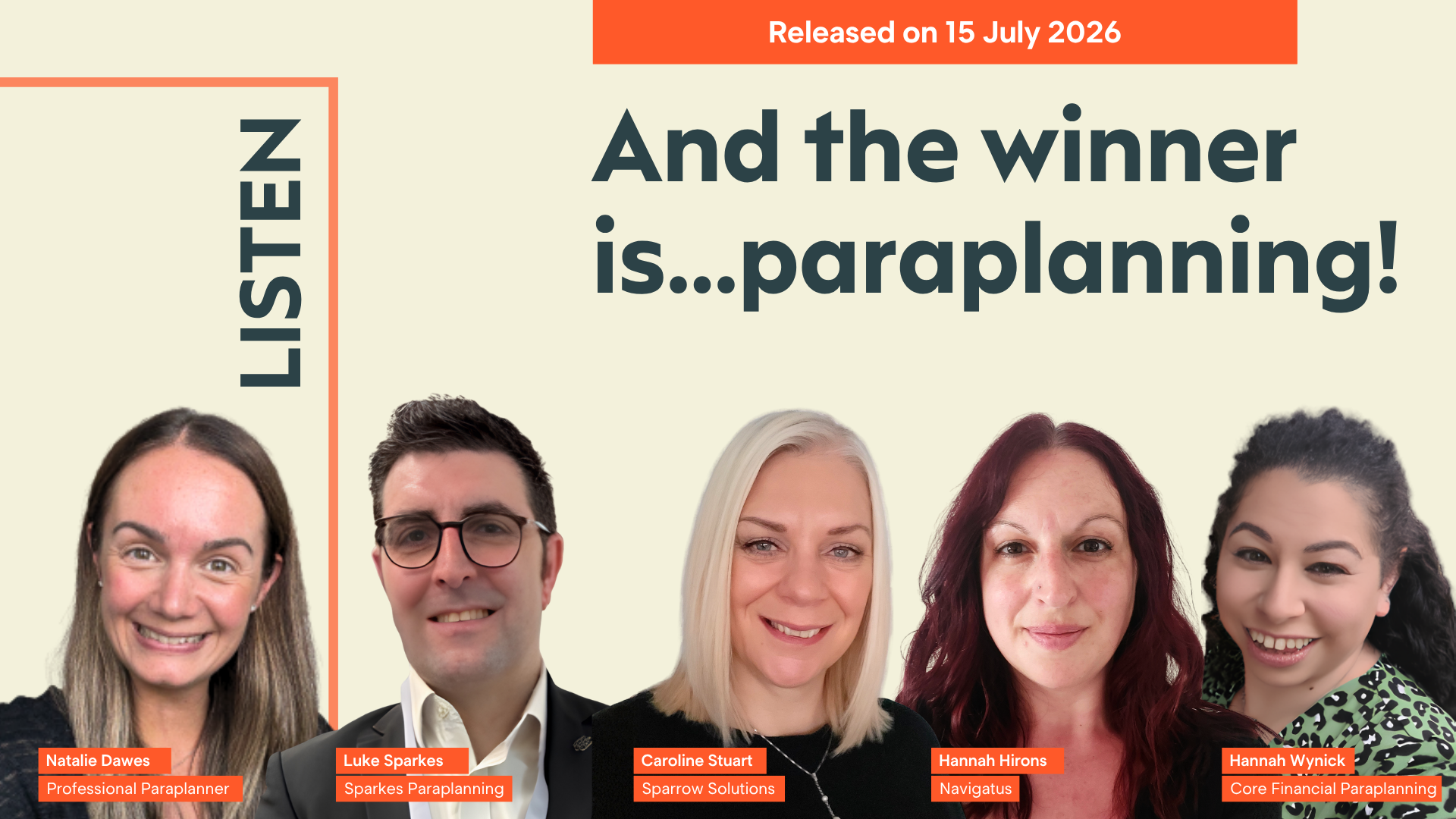
You’d be forgiven for thinking that a gathering of previous award winners could turn into a smugfest.
But it’s PARAPLANNERS that we’re talking about.
So this episode – recorded specially to celebrate the tenth annual Professional Paraplanner Awards – is far from self-congratulatory. In fact, it’s packed with thinking that will inspire every paraplanner wherever you are in your career.
Why? Because it illustrates how entering an award – or even just thinking about it – is one of the most helpful ways to reflect on your career, what you’ve achieved and what you would like to achieve in the future.
Host Caroline Stuart of Sparrow Solutions is joined by Natalie Dawes, editor of Professional Paraplanner, along with three paraplanners who’ve been through the process themselves: Hannah Hirons of Navigatus, Luke Sparkes of Sparkes Paraplanning, and Hannah Wynick of Core Financial Paraplanning.
In an hour-long chat they talk about
- overcoming your imposter syndrome
- why nominating yourself is OK even when it might not feel like it
- why being nominated by someone else feels ACE
- whether there’s a difference entering awards when you’re in-house versus outsourced
- why writing an award entry helps you realise what you’re actually good at
- what it’s like to sit in an interview with judges – and why it’s so valuable
What’s more, the conversation also recognises that some people just don’t want to enter awards or feel the need to do so and explores ways in which paraplanners can receive the recognition their work deserves.
Above all, this is an episode that illustrates how powerful it can be for paraplanning practitioners to reflect on their professional progress. And how the peer-led evaluation of entries has quickly established the Professional Paraplanner Awards as the preeminent standard for the paraplanning profession.
An odd feature of paraplanning is that quite a bit of our time is spent designing strategies that are all about the inevitability of death but – just like in our everyday lives – lots of our clients seem reluctant to talk about death and dying and being prepared for it.
Yet the financial grief that families and friends face following a death serves only to compound the overwhelming emotional kind.
That’s what this Assembly is all about. Kylie Clark of Wealthtime, Katy Hancock of Dorothy House Hospice Care and Lucy Halliday from Argonaut Paraplanning joined Richard Allum to talk about death and dying.
Because at a time when a growing percentage of clients are reaching an age when they should be dotting the i’s and crossing the t’s in plenty of time before they die, what can paraplanners do to help them get death-ready?
What you’ll learn
- Out-of-date expression of wish forms, account and app passwords, overseas accounts, tracking down former advisers and solicitors – what are the biggest and most frequent problems following death? And what can clients and their families do to avoid them?
- The way firms handle bereavement is one of the most significant sources of complaints across financial services. With bereavement support about to come under the FCA’s spotlight, what can advice practices do to improve things?
- Learn how the ‘last 1,000 days’ concept could offer a lens to help clients and their families plan
- Grief isn’t just the client’s, it’s the paraplanner’s too. How we’ve been able to acknowledge grief in the past influences how we’re able to help clients experiencing it now and in the future.
Watch or listen now
Paraplanners from all across the UK got together to share ideas, ask questions and break the big taboo about death. Plus there’s one hour’s CPD available.
Missed it? Then follow the links below and watch the replay or catch up with the podcast now.
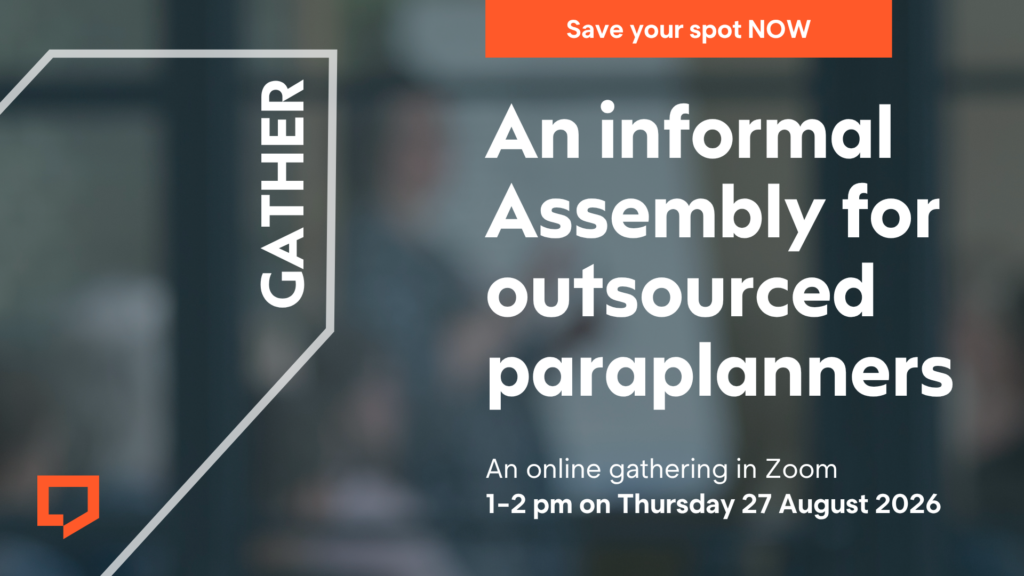
Are you an outsourced paraplanner?
Whether you’re the only employee of your paraplanning practice, or you lead a paraplanning powerhouse with employees and a hefty bank of clients, outsourced paraplanners share lots of things in common.
You just do.
But here’s the thing: despite the growing number of outsourced paraplanners in the UK these days, opportunities to get together to talk only about things that matter in the outsourced world, are surprisingly few and far between.
Switch off. Show up. Join in.
So, if you’re an outsourced paraplanner, here’s our invitation: at 1pm on Thursday 27 August 2026, set your notifications to ‘do not disturb’, click on the Zoom link in your event invitation and gather with other outsourced paraplanners across the UK for an hour of conversation, ideas and practical insights.
There’s nothing to prepare.
We’re starting this Assembly discussing fees and see where it goes from there.
Spaces are limited. To save a spot hit ‘Book Event’ and look out for the calendar invitation in your inbox.
We all have pension questions we’ve never quite got round to asking. Maybe the moment wasn’t right. Maybe the right expertise wasn’t around. Maybe you just didn’t want to be the one to ask.
That’s why in this Assembly, we staged a pension intervention. Because host Richard Allum posed the most pressing pension-related questions to someone who just loves answering them: Quilter’s retirement and pension technical specialist, Adam Cole.
Over one lunch hour, we worked our way through pension topics that either crop up regularly in client cases or maybe just leave you scratching your head from time to time. Things like:
- Transitional tax-free cash, lump sum allowances and lump sum death benefit allowances
- Taking tax-free cash after 75 and the implications
- Taking protected tax-free cash and moving into drawdown
- How defined benefit pensions work
- Guaranteed annuity rates, guaranteed cash sums and other features of older-style contracts
What can you expect to take away?
Watch or listen now to brush up on your pension knowledge. And don’t forget to follow the link below to download your certificate for CPD.
The rules are changing and from April 2027 and unspent pension pots will fall within the scope of inheritance tax. Draft legislation is now published, and there’s plenty for paraplanners to get to grips with.
This Assembly looks at how we got here, and where we need to go with less than nine months to go. We looked at what the May 2026 HMRC technical note and draft legislation actually confirmed, what it means in practice, and, what it means for the planning advice paraplanners are helping to shape right now.
On 1 July 2026, host Richard Allum was joined by guest Mark Devlin, Senior Technical Manager at M&G, to practically address some of the trickier questions the changes raise.
Together, they covered:
- The background: how we got here, and what the consultation process did and didn’t address
- Discretionary vs directed schemes: a refresher on the distinction and why it matters for IHT treatment
- How the new process will work in practice, including the role of personal representatives
- Planning implications: is it still worth funding a pension, and at what level?
- Balancing pension use for retirement income against IHT exposure, and keeping an eye on taxable funds for beneficiaries
- A common income tax misconception, and why some recent press coverage has muddied the water
What can you expect to take away?
At the end of this Assembly, you’ll have a better understanding of the confirmed changes, a better grasp of the planning considerations that flow from them, and some practical frameworks to bring to your paraplanning work, whether you’re reviewing existing pension strategies or helping to shape new ones.
We got together online at 1pm on Wed 17 June 2026 for The Self-Assembly Paraplanning Show.
Why ‘Self-Assembly’? Because host Sam Tonks and guests Alan Gow, Jackie Manning and Kimberley Malin started out with four talking points to cover in one lunch-hour. The topics were
– how the paraplanning year has gone so far
– what’s coming up for paraplanners
– what could be a thing but isn’t yet, and
– what events and resources they’re recommending right now
The result is a wide-ranging conversation that takes in mixed feelings about AI (it’s handy for handover emails, but when it’s confidently wrong..?), chat about rising role of annuities and gifting from excess income, plus questions about the decline of cash, what advice might look like in the future if so-called ‘finfluencers’ are allowed to continue to ‘finfluence’.
Fancy tuning in? Then watch or listen now
Host Leanne Pickering from Pivotal Paraplanning is joined by James Jones-Tinsley, self-invested pensions technical specialist at Barnett Waddingham, to catch up on what’s been happening in Parliament and politics and what it means in practice for paraplanners and their clients.
They cover the:
- local election results
- state opening of Parliament
- new Enhancing Financial Services Bill
- Pension Schemes Act 2026 and the salary sacrifice changes due in April 2029; and
- HMRC technical note on IHT and pensions – including what’s still unclear and why that’s causing real headaches for estates that need to be settled within six months of death.
There’s also a discussion about what a change in Labour leadership might mean for the pensions landscape, and whether the IHT on pensions rules could yet change before April 2027.
If you’ve been keeping one eye on the news and another on a client’s estate plan, this one’s well worth your time.
Setting up your own outsourced paraplanning business can be an exciting prospect but going into it with your eyes open and with the benefit of other people’s hard-won experience makes for a much stronger start.
On Wednesday 3 June, our guests had an honest, practical conversation about what it really takes to start an outsourced paraplanning business.
Host Richard Allum was joined by three paraplanners who’ve recently been through the process: Jawaad Tanwir founder of ParaplanX, Ellie Bailey founder of Paraflo, and Phillip Williams of Beyond Paraplanning (and author of ‘What If?…: A Guide To Working Smart & Building Your Own Path In Paraplanning‘).
Together they reflected on their own experiences and shared what they’ve learned, covering:
- what the outsourced paraplanning market looks like right now, and whether it’s a good time to be thinking about this
- the questions worth asking yourself before you take the leap and how to know if it’s genuinely what you want
- how to go about setting up an outsourced business in practice
- what they wish they’d known at the start, and what they’re still figuring out
- how they’re finding balance in work, in business, and beyond
What can you expect to take away?
After tuning into this Assembly, you’ll leave with a clearer picture of what outsourced paraplanning business life actually looks like including the opportunity, the reality, and the things worth thinking through before you commit. Whether you’re seriously considering it or just curious, this is an opportunity to hear from people who’ve been exactly where you are.
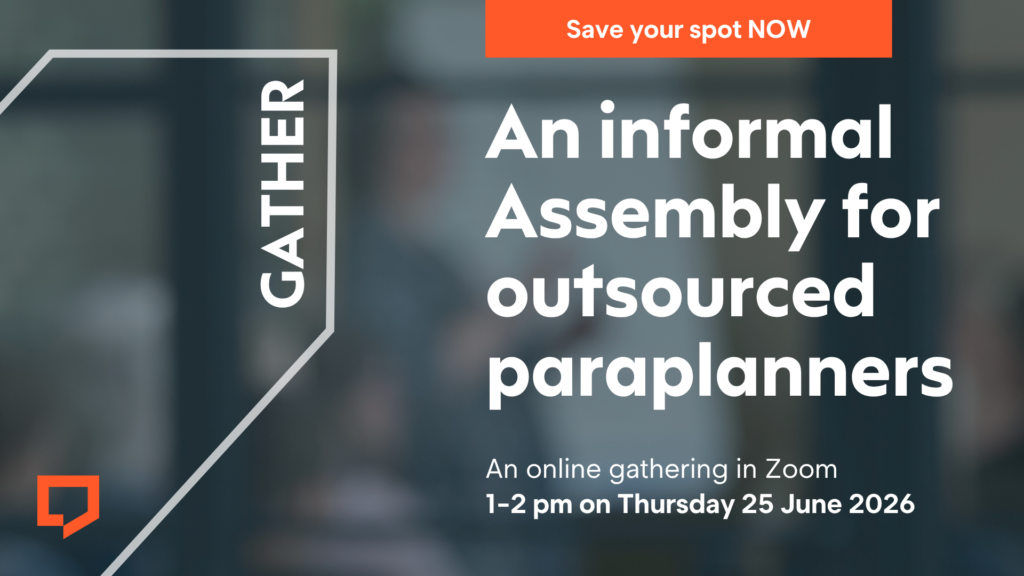
Are you an outsourced paraplanner?
Whether you’re the only employee of your paraplanning practice, or you lead a paraplanning powerhouse with employees and a hefty bank of clients, outsourced paraplanners share lots of things in common.
You just do.
But here’s the thing: despite the growing number of outsourced paraplanners in the UK these days, opportunities to get together to talk only about things that matter in the outsourced world, are surprisingly few and far between.
Switch off. Show up. Join in.
So, if you’re an outsourced paraplanner, here’s our invitation: at 1pm on Thursday 25 June 2026, set your notifications to ‘do not disturb’, click on the Zoom link in your event invitation and gather with other outsourced paraplanners across the UK for an hour of conversation, ideas and practical insights.
There’s nothing to prepare.
We’re starting this Assembly discussing fees and see where it goes from there.
Spaces are limited. To save a spot hit ‘Book Event’ and look out for the calendar invitation in your inbox.
Trusts used to be the kind of thing you’d come across every now and again. Something to dust off the knowledge for, handle carefully, then put back on the shelf.
That’s changing. With pension IHT changes on the horizon, trust planning is becoming a regular fixture on paraplanners’ desks and the paraplanners best placed to support their clients will be the ones who can approach it with genuine confidence, not just familiarity.
This Assembly is designed to help you get there.
This practical Assembly takes you from the foundations right through to real-world trust planning decisions.
Shaun Moore, Tax and Financial Planning Expert at Quilter, joins host Richard Allum for this Assembly. Together they work through the essentials and the less obvious bits that every paraplanner working with trusts needs to have at their fingertips.
During this Assembly, we:
- explore why trust planning has moved from the occasional to the everyday, and why the pension IHT changes expected from April 2027 are likely to accelerate that further
- get to grips with the types of trust you’re most likely to encounter (loan trusts, discounted gift trusts and reversionary interest trusts) and how to tell them apart when different providers call them different things
- use the three circles of access, flexibility and tax efficiency as a practical framework for matching the right trust to the right client
- explore the common mistakes and questions that come up again and again
- understand the ongoing practical obligations that come with trusts, from the Trust Registration Service to trustee bank accounts, and when a professional trustee makes sense
What can you expect to take away?
You’ll leave with a clearer, more confident grasp of trust planning, not just the theory, but the practical judgement to apply it. Whether you’re doing in-depth trust research or writing up recommendations that involve one, this session gives you a framework and a reference point you can keep coming back to.