
Salary sacrifice – or salary exchange – has been around for ages. But a proposal in last autumn’s Budget to cap the national insurance relief available on pension contributions has brought it into sharp focus.
We racked our brains but don’t think that we’ve ever explored the essentials of salary sacrifice for paraplanners so, while the Finance Bill is making its way through Parliament, we decided to invite Lucy Clark and James Jones-Tinsley from Barnett Waddingham to tell us what it’s all about and what’s changing in future.
Lucy explains:
- what salary exchange actually is
- the national insurance savings it can unlock – for employees and employers
- the different ways to structure it
- the things that can go wrong
James rounds off the 30-minute briefing by explaining the latest on the progress of the proposed cap, which is due to come into effect by 6 April 2029, and why its final form is far from settled – and may not even happen.
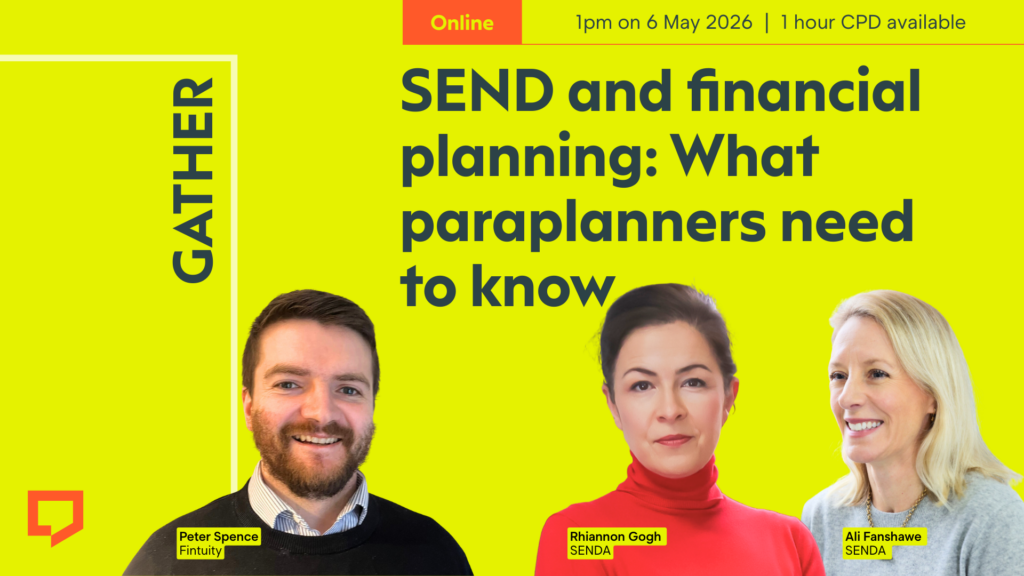
Think about the last time you worked on a financial plan for a family with a child or adult with special educational needs or a disability. How confident were you that the plan truly reflected what that family needs, not just now, but for the long term?
Families that include someone with special educational needs or a disability (SEND) face a distinctive set of financial challenges that conventional planning approaches often aren’t equipped to handle. The numbers are significant: around 638,700 (January 2025) children in England alone have an Education, Health and Care Plan. Behind each of those is a family navigating a lifetime of complex decisions about benefits, trusts, housing, care funding, and more. Get the planning wrong and the consequences can be serious.
As paraplanners, we’re in a position to make a real difference but only if we understand what good planning for these families actually looks like.
A chance to better understand special needs planning in one lunch hour
Join us online at 1.00 pm on Wednesday 6 May as we explore what paraplanners need to know to support families with SEND needs.
Peter Spence from Fintuity hosts this conversation with Ali Fanshawe and Rhiannon Gogh, co-founders of SENDA; specialists who work with financial, legal and charity advisers to deliver safer, smarter planning for SEND families.
Together, they’ll explore what special needs planning really involves, where traditional advice tends to fall short, and what paraplanners can do to fill that gap.
During this lunch-hour Assembly we expect to:
- understand how many families are affected and what the financial planning picture looks like on a personal level
- explore the real consequences of getting financial planning wrong for families with SEND needs
- identify the key problems that arise in a financial planning context and why standard approaches can miss the mark
- consider what good planning looks like
- Understand the support available to equip paraplanners with the knowledge needed to support families confidently
What can you expect to take away?
You’ll leave with a clearer understanding of where special needs planning is different. You’ll get a better understanding of what to consider when planning for SEND needs and, and where to go for training and support if you want to develop your knowledge further.
This is planning that can make a genuine difference to families who need it most — and a chance to make sure you’re equipped to deliver it.
Ready to find out more? Register now.

When a client is moving into retirement and suddenly becomes far more aware of every market dip, smoothed funds can feel like an obvious solution. But how well do you really understand what’s happening under the bonnet?
More providers are launching smoothed funds, which means they’re cropping up more often in research and recommendations. Yet the mechanics and the meaningful differences between the various types aren’t always well understood. If you’ve ever found yourself focusing more on the smoothing overlay than the underlying fund, this session is for you.
Almost everything you need to know about smoothed funds in one lunch hour
Join us online at 1.00 pm on Wednesday 8 April for a practical, product-agnostic look at how smoothed funds actually work, hosted by first time Assembly host, Jawaad Tanwir, with Edward Green from M&G.
Ed will start where it makes most sense to start: with the client. Why do smoothed funds exist at all? What role does psychology play in the transition into retirement, and when does reducing short-term volatility genuinely serve a client’s interests? From there, the conversation will get into the detail paraplanners need.
During this Assembly, we expect to cover:
- the three main types of smoothed fund, conventional with-profits, future expectation of returns (such as the EGR model), and backward-facing averaging, and what distinguishes them
- why smoothed funds tend to carry higher costs than conventional multi-asset funds, and what those costs are buying
- scale, structure and smoothing as a framework for evaluation
- private market exposure and how it contributes to lower-volatility returns
- what to actually look at when you’re researching these funds (hint: start with the underlying multi-asset fund, not the smoothing overlay)
What can you expect to take away?
You’ll leave with a clearer understanding of smoothed funds. You’ll be able to cut through the product noise and research them with more confidence. Whether you’re encountering smoothed funds for the first time or want to sharpen your existing knowledge, this is a practical session designed to give you exactly what you need to do your job better.
Sound useful? Save your spot now.
Are you an outsourced paraplanner?
Whether you’re the only employee of your paraplanning practice, or you lead a paraplanning powerhouse with employees and a hefty bank of clients, outsourced paraplanners share lots of things in common.
You just do.
But here’s the thing: despite the growing number of outsourced paraplanners in the UK these days, opportunities to get together to talk only about things that matter in the outsourced world, are surprisingly few and far between.
Switch off. Show up. Join in.
So, if you’re an outsourced paraplanner, here’s our invitation: at 1pm on Thursday 30 April 2026, set your notifications to ‘do not disturb’, click on the Zoom link in your event invitation and gather with other outsourced paraplanners across the UK for an hour of conversation, ideas and practical insights.
There’s nothing to prepare. Just come along ready to share your answer to one question:
‘What’s on your mind today?’
Spaces are limited. To save a spot hit ‘Book Event’ and look out for the calendar invitation in your inbox.
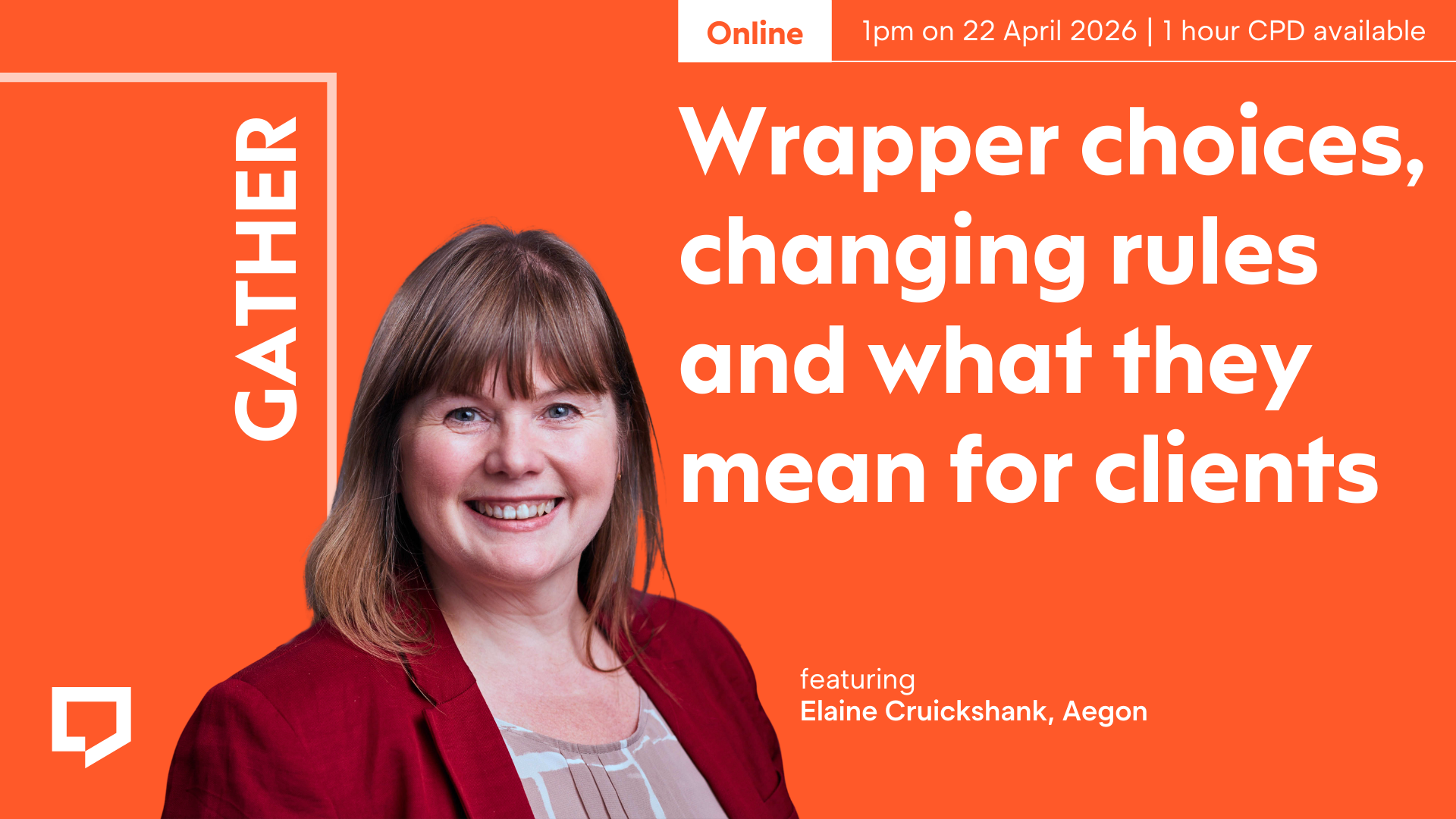
The tax landscape has shifted significantly over the past couple of years. Allowance reductions, rising dividend tax rates and the proposed extension of IHT to unused pensions means there’s plenty for paraplanners to get to grips with — and plenty of opportunity to add real value for clients.
This Assembly is designed to cut through the complexity and give you a clearer picture of how different tax wrappers work in practice, so you can make more confident decisions about which solution is right for which client.
We’ve invited Elaine Cruickshank, tax and trusts manager at Aegon, to join host Richard Allum for a practical, no-nonsense look at onshore bonds, offshore bonds, GIAs and trust solutions — with an agnostic perspective that keeps the focus firmly on what’s best for the client in front of you.
What we’ll be exploring
We’ll look at how recent tax changes are prompting advisers and paraplanners to revisit wrapper choice, and walk through the kind of comparative thinking that helps you work out when a bond might be preferable to a GIA — or when onshore makes more sense than offshore.
We’ll also take a look at how onshore bonds are actually taxed (including a common misconception that’s worth clearing up), which wrapper tends to suit which client circumstances, and how trust solutions fit into the picture — particularly in the context of the proposed IHT changes to pensions.
What can you expect to take away?
You’ll leave with a clearer understanding of the tax treatment of different wrappers, a more confident sense of when each option is likely to work best, and some practical frameworks for thinking about trust planning solutions. We’ll share the comparative calculations in the slides afterwards, so you can refer back to them whenever you need to.
Whether you’re looking to sharpen your technical knowledge or just want to feel more confident having these conversations, join us online at 1.00 pm on Tuesday 22 April.
Think about the last financial plan you worked on for a couple.
Who led the conversation? Whose risk profile shaped the recommendations? And if one partner wasn’t at the meeting – or didn’t really engage when they were – how much of a difference did that make to the plan you produced?
If you’re not sure, that might be the point.
As paraplanners, we work with the information we’re given. But some of the most consequential decisions in financial planning – which pension gets the contributions, how retirement income is structured, what happens when one partner dies – can be based on assumptions that nobody has explicitly questioned. And more often than not, it’s women who are most exposed when those assumptions go unexamined.
This Assembly is a chance to look at three of those assumptions directly: where they come from, what they cost clients, and what paraplanners can do about them.
Three recurring assumptions that could be impacting women’s financial future
We’ve chosen three assumptions that come up again and again in financial planning for couples, and that can have a disproportionate impact on women’s financial outcomes.
They span different life stages, so wherever your clients are in their financial journey, there’s likely to be something that resonates.
For each one, we explored how it shows up in real planning situations, what can go wrong for clients, and what the risks are – before asking the practical question: what can a paraplanner actually do about it?
Paraplanner Sam Tonks hosted this Assembly alongside chartered financial planner at Women’s Wealth founder, Sam Secomb and Susan Hope, Business Development Director at Scottish Widows.
Together they worked through each assumption, shared practical ideas, and had a (very)honest conversation about how paraplanners can raise these issues with planners in a way that gets heard.
We covered
- How planning assumptions form in practice – and why the ones nobody questions are often the ones that cause the most damage
- The compliance and consumer duty implications when planning has only really engaged one partner in a couple
- What can go wrong for clients at different life stages when assumptions go unexamined – and what it costs them
- The risks for the business, and how to demonstrate on the file that you’ve done the right thing
- How to raise these issues with a planner in a way that comes across as risk mitigation, not criticism
- Practical things you can put in place – in the file, in your processes, and in your conversations – that make a real difference
What can you expect to take away?
You’ll leave this Assembly with a clearer picture of where the gaps are most likely to appear in plans for couples, and with practical ideas you can start using straight away.
That might mean a question you’ve not thought to ask before. A check you add to your review process. A way of framing a conversation with a planner that makes it easier for them to hear. Or simply a sharper sense of where your paraplanning skills can make the most difference to the people you’re planning for.
The assumptions we look at are ones that affect real clients in real ways – and paraplanners are often the best-placed people in the room to notice them.
Catch up now.
We’ve been recording ‘Technically speaking’ sessions with Utmost’s Steve Sayer for a few years now.
And because they offer really crunchy case-study based content, they’re really popular with paraplanners.
But we like to plan ahead so late last year, we sat down with Steve and the team at Utmost to talk about the ‘Technically speaking’ plans for 2026. During the conversation, Steve talked about each of the major tax planning milestones that stem from the measures announced by the Chancellor since October 2024 and stretch ahead to 2031.
And when Steve revealed that he had a single slide that set out each of the changes against a timeline, we decided – there and then – that was definitely something paraplanners would like to hear more about.
So we invited Steve into the studio to talk us through it.
And here’s the result: Steve Sayer’s guide to the tax change timeline until April 2031. In it, Steve covers inheritance tax and the domicile regime, excluded property trusts and the new foreign income and gains regime, the agricultural and business property relief changes, pension death benefits in 2027, plus the effects of the freezing of tax bands until 2031.
Plus you can download his slide using the link below.

Are you an outsourced paraplanner?
Whether you’re the only employee of your paraplanning practice, or you lead a paraplanning powerhouse with employees and a hefty bank of clients, outsourced paraplanners share lots of things in common.
You just do.
But here’s the thing: despite the growing number of outsourced paraplanners in the UK these days, opportunities to get together to talk only about things that matter in the outsourced world, are surprisingly few and far between.
Switch off. Show up. Join in.
So, if you’re an outsourced paraplanner, here’s our invitation: at 1pm on Thursday 26 February 2026, set your notifications to ‘do not disturb’, click on the Zoom link in your event invitation and gather with other outsourced paraplanners across the UK for an hour of conversation, ideas and practical insights.
There’s nothing to prepare. Just come along ready to share your answer to one question:
‘What’s on your mind today?’
Spaces are limited. To save a spot hit ‘Book Event’ and look out for the calendar invitation in your inbox.
Pensions will become subject to inheritance tax (IHT) from April 2027, but how much of a role does protection play in your approach to building IHT strategies for your clients? And how confident are you about the protection options that are available to you?
But with IHT receipts expected to almost double, and sweeping changes to business and agricultural property relief already landing from April 2026, paraplanners can expect more and more clients to want to explore all the options.
So at this Assembly, host Richard Allum was joined by Alan Jenkinson, protection specialist at Scottish Widows, to walk through the essentials. During their lunch-hour discussion, Richard and Alan unpack IHT and how it works, run through the key exemptions and reliefs, and explore how protection fits into an IHT planning conversation alongside gifting strategies, trust structures and the normal expenditure out of income rules.
There’s also a really useful section on the underwriting process: what to do when a client has health risk factors, when concurrent applications make sense, and why a declined application isn’t necessarily the end of the road.
If you’re looking for a solid grounding in this area — or a practical refresher before your next client review — this one’s well worth an hour of your time.
Back in November, guests from CISI, PFS and LIBF joined us to talk about what the professional bodies can do for paraplanners. (If you missed part 1, you’ll find it here.)
But there was too much to cover in just one session. So we invited Nicola Mellor (PFS), Chris Morris (CISI) and Sally Plant (LIBF) back to pick up where they left off.
This time around, they answered questions including which body to join and why, exams and qualifications, the role of CPD and how paraplanners can influence the work of professional bodies.
What you’ll hear
We structured this Assembly around six key areas that came up most often from paraplanners:
- Starting out in the profession: which body to join, what membership actually costs, what support exists for career changers, and what you should prioritise in your first year
- Qualifications and exams: how exams are structured, why they feel designed to catch you out rather than test real knowledge, and whether there’s appetite for more specialist paraplanning qualifications
- Recognition of paraplanning: whether we’ll ever see chartered paraplanner titles, why paraplanning isn’t recognised as distinct from financial planning, and what’s stopping this from happening
- CPD that actually works: why you should need to sit in an exam room if you already manage your own learning, why all the CPD events cluster together, and why you hear budget updates from everyone except the body you actually belong to
- Having your say: how to get involved, whether there’s paraplanner representation on boards, what mechanisms exist to propose changes, and what volunteer opportunities are available
- The future of paraplanning: where the profession is heading and how the bodies are preparing to support paraplanners through changes in technology, regulation and client expectations
What can you expect to take away
You’ll leave with a much clearer understanding of what each professional body offers, which matters when you’re making decisions about where to invest your time and money.
More importantly, you’ll know exactly how these organisations work, how you can influence them, and whether they’re actually listening to what paraplanners need — not just what they think you need.
This is also a chance to hear the professional bodies respond directly to some uncomfortable questions about cost, accessibility, and whether they truly recognise paraplanning as a profession in its own right.